StepFun Releases Open Weights for Step 5 Preview
AI startup StepFun has made the weights for Step 5 Preview freely available, providing developers with a 600-billion-parameter open model optimized for long-context agentic tasks.
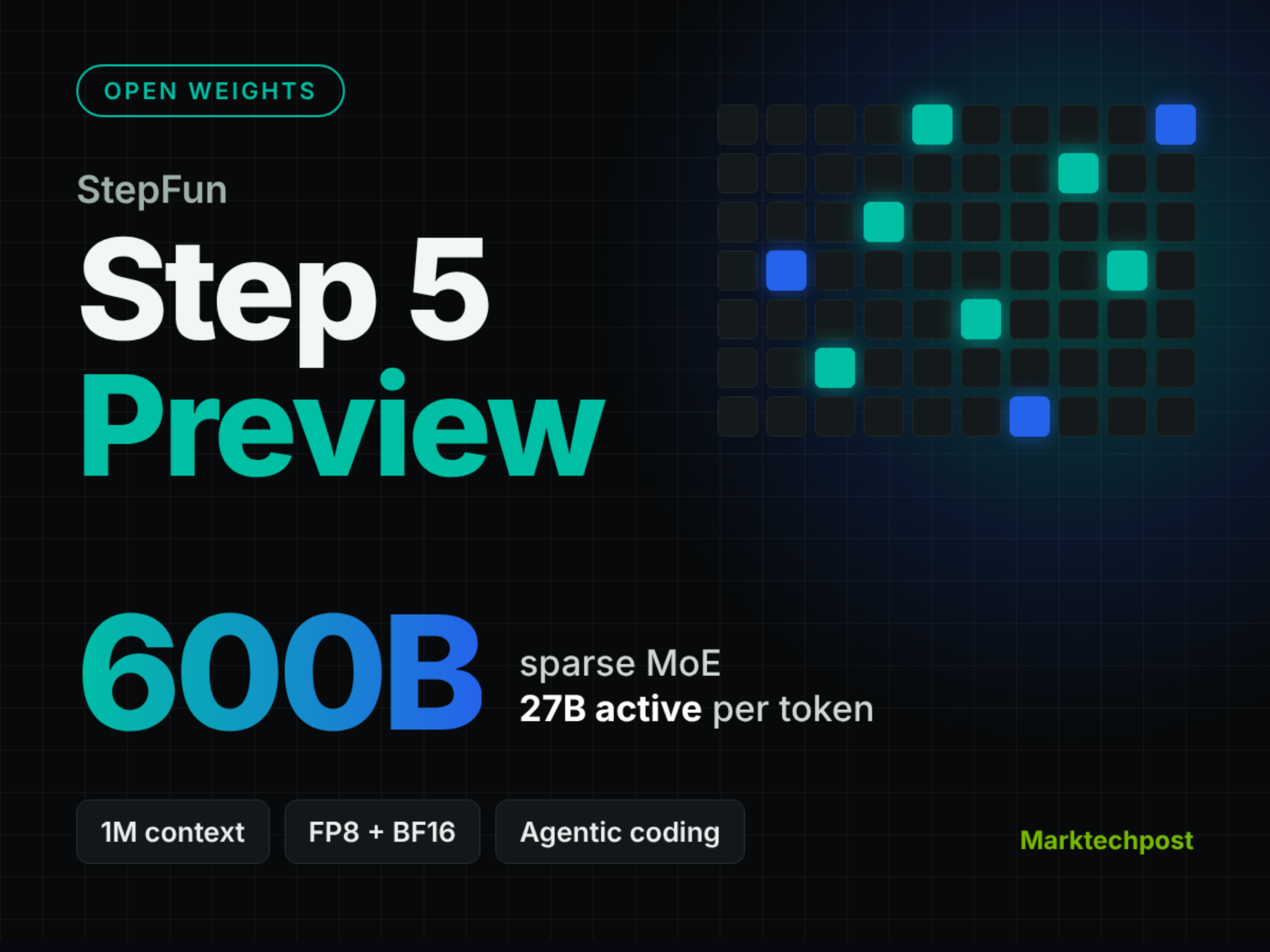
StepFun has published open-weight FP8 and BF16 checkpoints for its Step 5 Preview model on Hugging Face and ModelScope, following its September 20 API deployment and October 14 weight release. The sparse Mixture-of-Experts architecture features 600B total parameters with 27B active per token and a 1M-token context window. Built for complex agentic workflows, the model uses a deep 92-block transformer layout, combining gated sliding-window and full attention layers in a 3:1 ratio. Its sparse grouped-query attention selects 4,096 historical tokens per query in blocks of 8, while an MTP-3 speculative decoding head offers an estimated 30 percent speed boost. StepFun trained the system using FP8 mixed precision alongside reinforcement learning across million-scale verifiable environments.
Running the massive FP8 checkpoint—which spans 650.32 GB—requires enterprise hardware. Hosting FP8 via vLLM or SGLang demands either four B300 GPUs or eight H200 GPUs. The unquantized BF16 variant requires a single node of eight B300 GPUs or two nodes with 16 H200 GPUs. For organizations choosing API integration, usage costs $1.00 per 1M input tokens and $2.70 per 1M output tokens, with cache hits priced at $0.10 per 1M. StepFun recommends running inference using a temperature of 1.0, top_p of 0.95, and top_k of 0.
Evaluations reveal strengths in long-context reasoning alongside noticeable performance gaps. On Artificial Analysis benchmarks, Step 5 Preview logged an 88.3 percent score on AA-LCR, a 43.7 Intelligence Index rating, 46.5 percent on Humanity's Last Exam, and 54.3 percent on GDPval-AA. On FrontierFinance, its 66.4 percent mark topped GLM-5.3 at 64.1 percent and Kimi K3 at 62.6 percent, though it trailed Claude Opus 5 at 69.7 percent. In coding tests, the model scored 67.7 on DeepSWE v1.1, putting it ahead of GLM-5.3's 66.9 and Kimi K3's 67.5, but scored 33.3 percent on Terminal-Bench 4.0 compared to GLM-5.3's 41.9 percent. Severe bottlenecks appeared on specialised benchmarks, including 0.4 percent on SRE Bench and 9.2 percent on Harvey's Legal Agent Benchmark, leaving it behind closed-source systems like GPT-6 Astra.
For AI practitioners, these open weights grant self-hosted access to an ultra-large agentic framework under the StepFun Model License 1.0. Although high hardware requirements restrict local deployments to data centers, the release offers enterprise teams a self-hosted alternative for navigating codebases, processing long documents, and executing financial workflows.
This is our own summary of reporting by MarkTechPost