Toyota tasks workers with training ELEY humanoid robots
Toyota has begun using its assembly line workers to train its wheeled ELEY humanoid robots, marking a massive push to integrate 400,000 robots across its global manufacturing network.
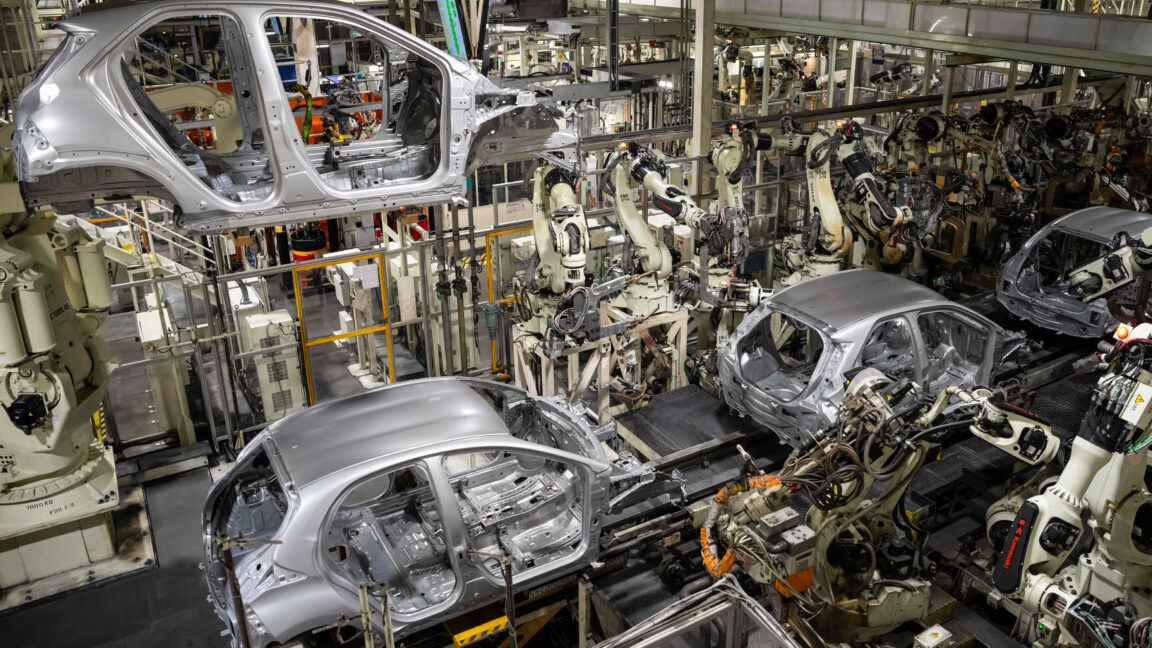
Toyota Motor group is preparing a massive automation push, planning to invest $6.42 billion annually starting in 2028 to upgrade its manufacturing facilities. The automaker aims to deploy 400,000 robots, distributing 150,000 across its own automotive plants and sending another 250,000 to group companies that manufacture various components and materials. As part of this initiative, human workers are currently training Toyota's wheeled ELEY humanoid robots on assembly lines, using specialized finger-mimicking jigs to teach the machines precise hand movements.
This aggressive automation strategy has raised concerns among Toyota's global workforce of 18,000 veteran employees across 60 factories, including 11 manufacturing plants in the United States. However, Toyota Executive Vice President Hiroki Nakajima downplayed fears of widespread layoffs, stating that the automaker envisions "a world where robots coexist with humans, rather than replacing them." The company hopes these general-purpose machines can eventually take over repetitive tasks within environments already optimized for human workers.
The shift toward humanoid robotics comes amid a global surge in industrial automation. In 2024, China led the world by deploying 2 million industrial robots, followed by Japan with 450,500, the United States with 34,200, and South Korea with 30,600. Toyota is not alone in this pursuit; South Korea's Hyundai plans to deploy up to 25,000 Atlas humanoid robots, developed by Boston Dynamics, across Hyundai and Kia plants starting in 2028. Boston Dynamics even opened a dedicated training center at Hyundai's Georgia Metaplant on September 21 to teach Atlas robots parts sequencing. Chinese EV makers like Xpeng and Nio are also investing heavily in similar technologies.
For automotive manufacturing engineers and system integrators, this transition highlights a shift from rigid, single-purpose robotic arms to flexible, autonomous humanoids. However, significant hurdles remain. Practitioners must still overcome hardware limitations, safety protocols for human-robot proximity, and high initial costs before these machines can be mass-produced and deployed at scale.
This is our own summary of reporting by Ars Technica AI